
Bespoke School & Academy Pathways
An Oxford cricket and leadership residency shaped around your institution.
About Bespoke School & Academy Pathways
Every school and academy brings a different group of students.
Some institutions are building a serious cricket pathway. Some want a leadership experience for selected student-athletes. Some need a shorter programme that fits the school calendar. Some want a girls’ cricket pathway. Some want stronger academic exposure, parent engagement, reporting, or a more balanced connection between cricket, Oxford and student development.
The Bespoke School & Academy Pathway is designed for institutions that want the OCO experience shaped around their own students, not forced into a fixed template.
The OCO philosophy remains the same: cricket is the medium, Oxford is the environment, and leadership is the outcome. What changes is the design of the pathway around the school’s cohort, calendar, cricket level and educational priorities.
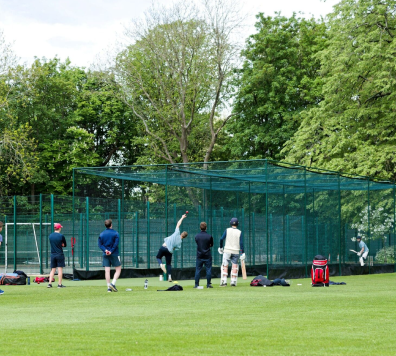
Built around your students
A bespoke pathway begins with understanding the students.
Their age, cricketing ability, confidence level, school culture, academic expectations, travel readiness and parent concerns all matter. A high-performance academy will need a different rhythm from a school introducing students to Oxford for the first time. A girls’ cricket cohort may need a different structure from a boys’ first XI. A mixed group focused on leadership may need a different balance from a squad preparing for competitive fixtures.
OCO works with the school or academy to shape the experience around the students who will actually travel.
The pathway can take into account:
- student age group and maturity level
- cricketing standard and match readiness
- boys’, girls’ or mixed cohort structure
- school calendar and exam pressure
- academic and leadership goals
- parent expectations and practical concerns
- desired level of reporting and post-programme evidence

What can be customised
The bespoke pathway can be shaped around what the school or academy is trying to achieve.

Bharat Ramanathan
COO & Co-founder
Bharat Ramanathan, co-founder of Oxford Cricket Odyssey and an Oxford alum, blends cricket passion with strategic leadership. His roles at Qualtrics, BAE Systems, and Deutsche Bank, along with his presidency at Oxford University Club CC, ensure unique, meticulously crafted cricketing experiences, merging academic rigor and cultural immersion at Oxford's historic venues.

Ashwani Arora
Co-Founder
Ashwani Arora, co-founder of Oxford Cricket Odyssey, brings C-suite expertise from Domino's Pizza and DHL India. He led Domino’s expansion with 86 stores and now channels his passion for cricket, playing for India’s over-50 team. His fusion of corporate leadership and athletic excellence drives the venture’s success.
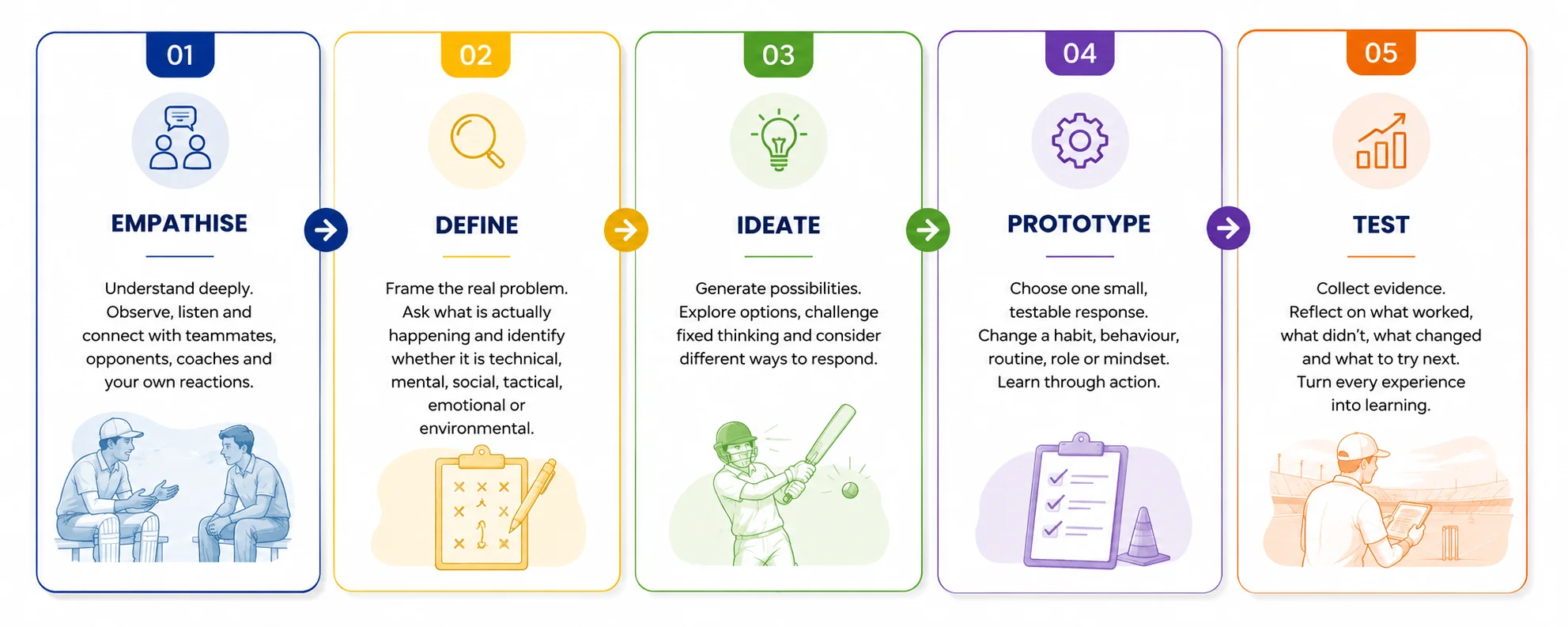
The Pavilion uses Design Thinking as a practical leadership method.
Students learn that progress does not begin with perfect answers. It begins with better observation.
1. Empathise
Students learn to understand deeply.
They observe teammates, opponents, coaches, parents, school expectations, pressure moments and their own reactions. They learn to listen before judging and to notice where assumptions break down.
2. Define
Students learn to frame the real problem.
Instead of rushing to easy answers, they ask: what is actually happening here? Is the problem technical, mental, social, tactical, emotional or environmental?
A well-defined problem gives students a stronger path forward.
3. Ideate
Students generate possibilities.
They learn to think beyond the first obvious answer. They explore options, challenge fixed thinking and consider different ways to respond.
This builds creativity, adaptability and confidence.
4. Prototype
Students choose one small, testable response.
They may change a communication habit, leadership behaviour, preparation routine, match-day mindset, team role or reflection practice.
The goal is not perfection. The goal is learning through action.
5. Test
Students collect evidence.
They ask what worked, what did not work, what changed, and what should be tried next. This turns each match, session and conversation into a learning opportunity.
What can be customised

Junaid Aziz
CEO & Co-founder
Junaid is CEO of Oxford Cricket Odyssey, offering exclusive educational cricket programs. He teaches design thinking at Stanford and advises the UN SDG Fund Secretariat. With expertise in luxury, education, and strategy, Junaid shapes impactful global initiatives through his innovative leadership

Abhishek Batra
Director Business Development
Abhishek blends a successful corporate career with a lifelong passion for cricket. A top academic performer and captain of multiple teams, he’s excelled in roles at KPMG, ICICI, and Kotak. His cricket journey includes winning "Cricket ka Ticket" and attending IPL training camps with Rajasthan Royals, marking a new chapter in his professional cricketing career.

Aisha Ahmed
Head of Education
Aisha Ahmad, a cricket enthusiast and Oxford PhD, specializes in law and governance in urban Pakistan. A Harvard LLM graduate and LUMS gold medalist, she teaches at LUMS and previously at Oxford. With extensive academic, public speaking, and debating experience, she brings her expertise to OCO, excited to introduce students to cricket in Oxford.

Stephen Wright
Philosopher and Director of Cricket Excellence & Leadership
Dr. Stephen Wright, a lecturer of Philosophy at Oxford and Head of Cricket Excellence & Leadership at Oxford Cricket Odyssey, leads a 15-day program for school teams. Blending physical training with philosophical insights, he uses cricket to teach leadership, resilience, and strategic decision-making, equipping students with skills for both academics and life.
The Odyssey Unfolds
The Six-Module Pavilion Journey
The Pavilion is designed as a six-module journey.
Four online modules prepare students before the Oxford residency. Two in-person sessions are embedded into the Oxford experience.
This means students do not arrive in Oxford as tourists. They arrive with language, intention and a framework for learning.
Online Preparation:
Students begin by understanding who they are as young athletes and learners.
They reflect on confidence, identity, pressure, ambition, strengths, habits and the kind of person they want to become.
Students learn to see cricket and education as systems.
They explore how coaches, teammates, parents, schools, selectors, routines, pressure, fitness, confidence and environment all influence performance and growth.
Students identify a real personal or team challenge.
They learn to move from vague statements like “I need to improve” to sharper problem definitions that can actually be worked on.
Students design a small response to their challenge.
This may involve communication, preparation, mindset, leadership, time management, reflection or team behaviour.
Oxford Residency:
During the Oxford residency, students test their ideas in real time.
Matches, academic sessions, debate, team life and cultural exposure become live material for learning.
Students consolidate what they have learned.
They return with reflections, outputs, feedback, certificates, reports or a development plan that helps them explain their growth clearly.
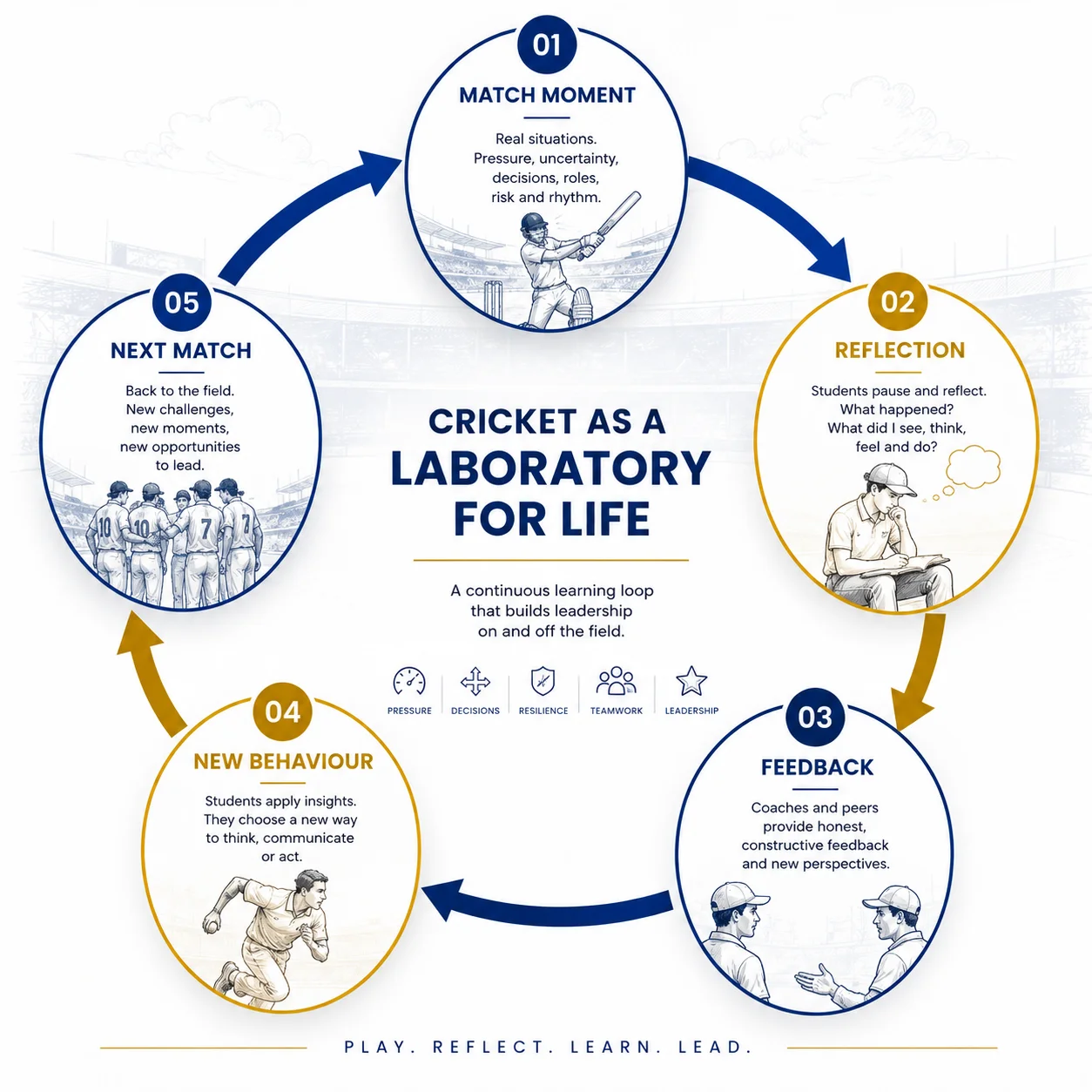
Cricket as a Laboratory for Life
Cricket gives the Pavilion its living material.
Every match contains pressure, uncertainty, roles, rhythm, risk, silence, failure, recovery and decision-making. A student can read about leadership in a classroom, but cricket asks them to practise it in real time.
A captain must communicate.
A batter must manage pressure.
A bowler must recover after being hit.
A fielder must stay alert when nothing has happened for ten overs.
A team must respond when the plan breaks down.
These moments are not only sporting moments. They are leadership moments.
The Pavilion helps students notice them, reflect on them and learn from them.
Scholar-Athlete Identity
The Pavilion helps students build a stronger scholar-athlete identity.
This matters because the best students are not only defined by grades or performance. They are defined by how they think, how they respond, how they communicate and how they grow.
For Students
For Students
Students gain a clearer sense of who they are becoming.
They develop confidence, reflection, communication, academic curiosity and a more mature language for their experiences.
They learn how to connect cricket, learning and personal growth into one story.
For Parents
For Parents
Parents see a more purposeful use of summer.
The Pavilion gives structure to the experience. It shows that the programme is not only about travel or matches, but about confidence, maturity, leadership and evidence of growth.
For Schools
For Schools
Schools receive a pathway that connects sport with holistic education.
The Pavilion supports the school’s wider mission: developing students who can think clearly, communicate well, work in teams, lead with judgment and return with documented learning.
What Students Bring Back
Students return with more than photographs.
Depending on the final pathway design, they may bring back:
- reflective journals
- short written tasks
- debate or presentation work
- leadership reflections
- cricket and performance observations
- feedback from coaches or mentors
- certificates
- personal development plans
- a final integrated student report
- clearer language around their own growth
The aim is to help students bring back evidence, not just memories.
Not Profile-Building. Formation.
The Pavilion is not designed to decorate a student’s profile.
It is designed to form the student behind the profile.
A polished essay can describe leadership. The Pavilion gives students moments where leadership has to be practised. A long activity list can suggest ambition. The Pavilion helps students turn ambition into language, evidence and direction.
Students do not simply claim growth.
They live it, reflect on it, document it and learn how to articulate it.
Bring the Pavilion Into Your School’s 2027 Pathway
The Pavilion of Possibility gives Oxford Cricket Odyssey its intellectual spine.
It prepares students before they travel, gives meaning to what they experience in Oxford, and helps them return as more reflective, articulate and confident young people.
For schools and academies, it offers a serious way to connect cricket with leadership, academic growth and future-readiness.
For students, it offers something rarer: a chance to understand not only how they play, but who they are becoming.

An Oxford residency for the next generation of scholar-athletes.
© 2026 Oxford Cricket Odyssey LTD. All rights reserved.
Cookies
© 2024 Oxford Cricket Odyssey LTD. All rights reserved.